
Do You Really Need ADAS Calibration After a Windshield Repair? Here’s the Truth
For decades, replacing a cracked windshield was a straightforward mechanical task. You’d call a glass specialist, they’d swap the glass, and you’d be back on the roads of Garland within the hour. But if you drive a vehicle manufactured in the last five to ten years, that “simple” piece of glass has evolved into one of the most critical tech components in your car.
At Fairway Auto Service, we’ve spent over 30 years watching automotive technology evolve. Today, your windshield isn’t just a shield against the wind and debris; it’s the mounting platform for the “eyes” of your vehicle: the Advanced Driver Assistance Systems (ADAS). If you’ve recently had a windshield repair or replacement, you might have been told you need a professional calibration. You might be wondering: Is this just an upsell, or is it a safety necessity?
Here is the truth about ADAS calibration and why skipping it is a risk you simply shouldn’t take.
The Invisible Connection: Why Glass Matters to Your Car’s Brain
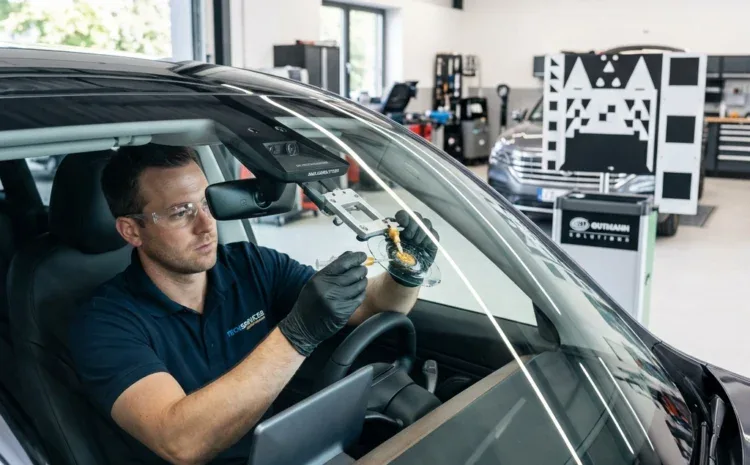
Modern vehicles are equipped with a suite of safety features designed to protect you and your family. These include Lane Departure Warning (LDW), Automatic Emergency Braking (AEB), Adaptive Cruise Control (ACC), and Pedestrian Detection. Most of these systems rely on a forward-facing camera mounted directly behind your rearview mirror, pressed against the glass.
When a windshield is replaced, that camera is unplugged and moved. Even if the new glass is an exact OEM (Original Equipment Manufacturer) match, the tiniest shift: as small as a single millimeter: can throw the entire system out of alignment.

The Math of Safety: Why One Degree Matters
Think of it like a flashlight. If you hold a flashlight and move your hand just a fraction of an inch, the beam of light 50 feet away moves several feet. Your ADAS camera works the same way.
Industry data shows that if a camera’s aim is off by just one degree, its “view” of the road can be off by as much as 8 feet at a distance of 100 feet. If your car thinks the lane line is 8 feet to the left of where it actually is, your Lane Keep Assist might pull you into oncoming traffic instead of keeping you centered. This is why common car problems aren’t always mechanical; sometimes, they are digital.
Symptom/Action: How to Tell if Your Calibration is Off
Sometimes, your car will tell you something is wrong. Other times, it will stay silent while the system fails in the background. If you experience any of the following after a windshield service, it is a clear warning sign your car needs immediate repair and calibration:
- Symptom: You hear frequent, unexpected “beeps” or warnings from your dashboard when there are no obstacles in sight.
- Action: Your sensors are likely misaligned and “seeing” ghosts or misinterpreting the road. Pull over and schedule a professional diagnostic.
- Symptom: Your steering wheel “jerks” or vibrates (Haptic feedback) unnecessarily when you are clearly within your lane.
- Action: The Lane Departure Warning system is miscalculating the lane markers. This requires a static calibration to reset the camera’s focal point.
- Symptom: You notice your Adaptive Cruise Control is following the car in front of you too closely or braking too late.
- Action: This is a high-risk situation. If the distance sensors are off, the “time-to-collision” math is wrong. Bring it to Fairway Auto Service immediately for advanced diagnostics.
- Symptom: An “ADAS Unavailable” or “Front Camera Malfunction” light appears on your dash.
- Action: The system has detected a fault and has likely disabled its safety features to prevent an accident. You are currently driving without your safety net.
The Two Types of Calibration: What We Do at Fairway Auto Service
At Fairway Auto Service, we don’t just “guess” at the alignment. We use dealership-level equipment to perform two specific types of calibration depending on your vehicle’s requirements.
1. Static Calibration
This takes place inside our specialized service bay in Garland. We use highly sensitive electronic tools and physical targets (similar to a specialized eye chart for your car). The vehicle must be on a perfectly level surface, with specific tire pressures and a full tank of gas to ensure the geometry is perfect. We then program the car’s computer to “learn” the position of these targets.
2. Dynamic Calibration
Some manufacturers (like Ford or Honda) require the vehicle to be driven at specific speeds on well-marked roads for a set amount of time. During this “learning flight,” the car’s computer monitors real-world lane markers and traffic patterns to fine-tune the camera’s perspective.

Why Choosing the Right Shop in Garland Matters
Many drivers in Garland, Dallas, and Mesquite assume that any glass shop can handle the calibration. However, ADAS work requires specialized training and expensive diagnostic software that many mobile glass repair kits simply don’t include.
If you choose a shop that doesn’t understand the complexities of modern systems, you could be leaving with a vehicle that is technically “functional” but fundamentally unsafe. At Fairway Auto Service, we combine our 30+ years of mechanical heritage with the latest technical certifications. We offer the same high-precision calibration you’d find at a dealership, but at the competitive, transparent pricing of a local, family-owned business.
The Risks of Skipping Calibration: It’s More Than Just a Light
We often hear customers ask, “Can I just wait until next month?” While we understand that auto repairs can be an unexpected expense, ADAS calibration is not a “maintenance” item like an oil change; it is a safety mandate.
- Liability: If you are involved in an accident and it is discovered that your ADAS system was compromised due to a lack of calibration after a windshield repair, your insurance provider may deny your claim.
- System Failure: In a panic-braking situation, if your camera is off by just a few degrees, the car might not apply the brakes until it’s too late.
- Wasted Investment: You paid for a modern car with modern safety features. By skipping calibration, you are essentially turning those features off or making them unreliable.
How Fairway Auto Service Makes It Easy
We know that dealing with car repairs is stressful. Our goal is to be your trusted advisor throughout the process. When you bring your vehicle to us for ADAS work, we follow a systematic, reliable process:
- Pre-Scan: We check your vehicle’s computer for any existing “hidden” codes.
- Precision Alignment: We ensure your suspension and wheel alignment are correct first, as a tilted car can’t have a level camera.
- OEM-Spec Calibration: We use the exact parameters set by your vehicle’s manufacturer.
- Post-Scan and Verification: We provide a digital report showing that the system is 100% active and accurate.

Don’t Compromise Your Safety
If you live in Garland, Dallas, or Mesquite, you know how unpredictable North Texas traffic can be. Whether it’s a sudden storm or a quick stop on I-635, you rely on your car’s safety systems to react when you can’t.
If you’ve recently had windshield work done, or if you’ve noticed your safety lights acting strangely, don’t wait. A quick visit to Fairway Auto Service can give you the peace of mind that your “invisible safety net” is working exactly as it should.
Ready to ensure your vehicle is safe? Contact us today to schedule your professional ADAS calibration. With over 30 years of experience, we provide the reliable service your family deserves.